
The short version
- Market words: contract, tick, tick value, point, micro, E-mini, margin, long and short.
- Order words: market, limit, stop and bracket orders, plus slippage.
- Risk words: position size and R multiple, the two that keep losses small.
- Prop firm words: evaluation, profit target, drawdown, trailing and end-of-day drawdown, daily loss limit, consistency rule and payout.
- Download the free one-page PDF with all 25.
Education, not financial advice. Contract values are from CME Group; prop rules vary by firm, so check your firm's own pages.
Trailing drawdown is the term I'd learn first. It's the one that ends most accounts.
Market terms
- Contract
- One unit of a futures market. You buy or sell whole contracts.
- Tick
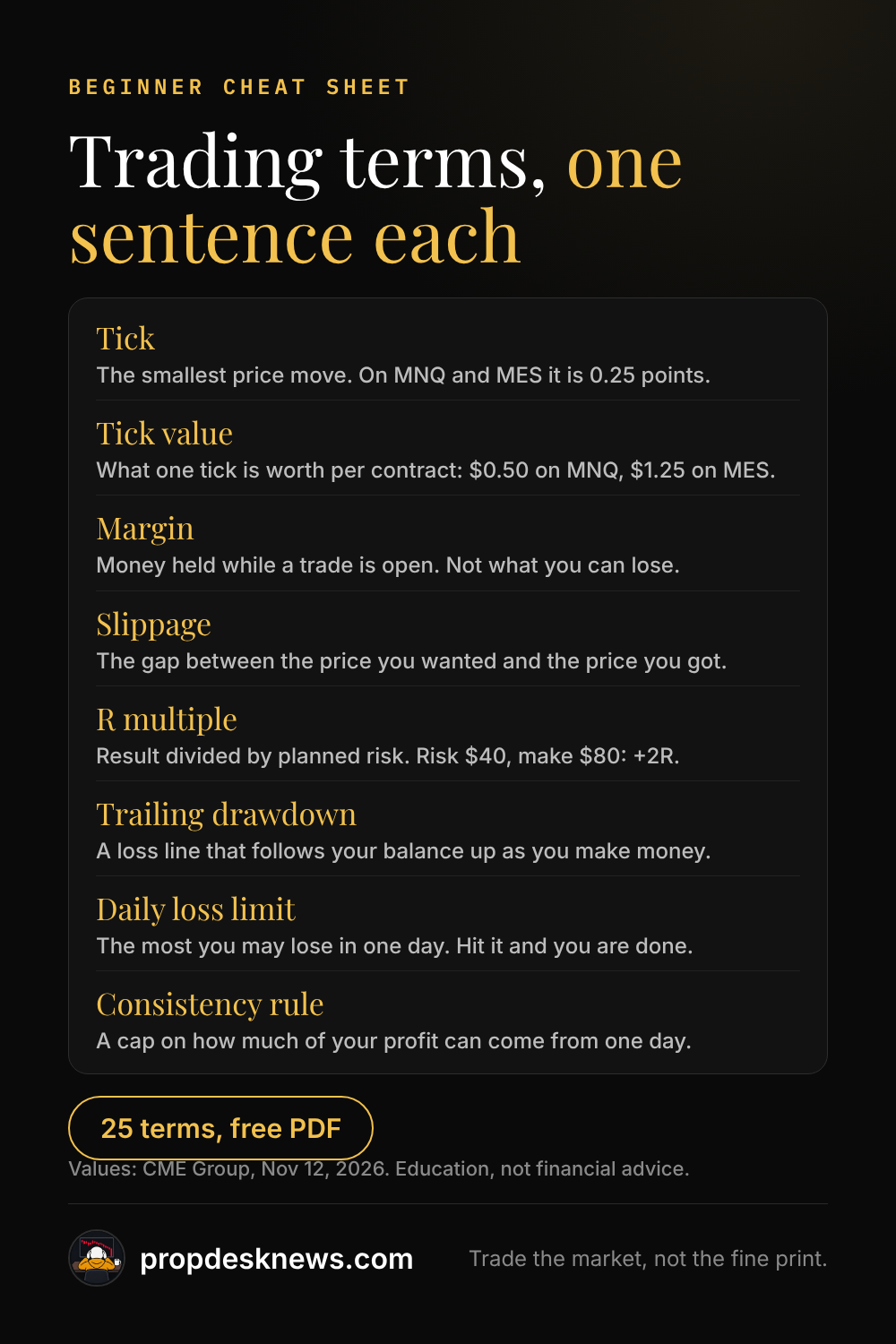
- The smallest price move a contract can make. On MNQ and MES it is 0.25 index points.
- Tick value
- What one tick is worth per contract: $0.50 on MNQ, $1.25 on MES (CME Group).
- Point
- One full index point. On MNQ and MES a point is 4 ticks: $2 on MNQ, $5 on MES.
- Micro contract
- A contract one tenth the size of its full-size pair. 10 MES move like 1 ES.
- E-mini
- The full-size index contracts most traders mean by "the minis": ES, NQ, YM and RTY.
- Margin
- Money the broker holds while a trade is open. It is the minimum to open a trade, not what you can lose.
- Long
- You bought, and you make money if price goes up.
- Short
- You sold first, and you make money if price goes down.
All 12 contracts' tick values are on the futures tick value cheat sheet.
Order terms
- Market order
- Buy or sell now at the best price available. Fast, but the price can slip.
- Limit order
- Buy or sell only at your price or better. You may not get filled.
- Stop order
- An order that becomes a market order when price reaches your level. Used to cap a loss.
- Bracket order
- An entry sent with a stop loss and a profit target attached, so both are set at once.
- Slippage
- The gap between the price you wanted and the price you got. Worst around news.
Risk terms
- Position size
- How many contracts you trade, set from your stop and the dollars you are willing to lose.
- R multiple
- Your result divided by the risk you planned. Risk $40 and make $80: that is +2R.
- Paper trading
- Practice trading with fake money in a simulator. No real money at risk.
Work out a position size with the position size calculator.
Prop firm terms
- Evaluation
- The paid test at a prop firm: hit a profit target in a simulated account without breaking the rules.
- Profit target
- The profit you need to pass an evaluation, often 6% to 10% of the account (about $3,000 on a 50K).
- Drawdown
- The most your account may fall before it is closed. A static drawdown never moves.
- Trailing drawdown
- A loss line that follows your balance up as you make money, including open profit during a trade.
- End-of-day trailing drawdown
- A trailing loss line that only moves once a day, from your closing balance.
- Daily loss limit
- The most you may lose in one day. Hit it and you are done until the next session.
- Consistency rule
- A cap on how much of your total profit can come from one day, for example 40% or 50%.
- Payout
- A withdrawal of your share of profit from a funded account, under the firm's minimums and schedule.
More prop terms, with what to check at each firm, are in our prop firm glossary.
Free printable cheat sheet (PDF)
All 25 terms on one page. Free, no email.
Save this cheat sheet
Questions
What is a tick in futures trading?
The smallest price move a contract can make. On MNQ and MES it is 0.25 index points.
What is the difference between margin and risk?
Margin is money the broker holds while a trade is open. It is the minimum to open a trade, not what you can lose.
What is a trailing drawdown?
A loss line that follows your balance up as you make money, including open profit during a trade.
Sources
Read on Nov 12, 2026:
- CME Group: Micro E-mini Nasdaq-100 contract specs ↗
- CME Group: Micro E-mini S&P 500 contract specs ↗
- Topstep Help Center: What is the Maximum Loss Limit? ↗
Spot something out of date? Email hello@propdesknews.com and we'll fix it.
Related guides
How prop firms really work: straight answers
Demo or live, who pays you, brokers, commissions, slippage and call-ups to live, answered from each firm's own rules.
Updated Nov 11, 2026

Pre-market trading checklist for futures traders
12 steps before the open, risk first. Free printable PDF.
Updated Nov 12, 2026

The 1% rule in trading, with real futures numbers
1% of $50K is $500 a trade. On a 50K prop account, that is a quarter of the drawdown.
Updated Nov 12, 2026