The short version
- Do the risk steps first: daily loss limit, a stop rule for the day, and your size, before you look at a chart.
- Check the economic calendar and your firm's news rule. Big releases like CPI, the jobs report and Fed decisions move futures fast.
- Mark yesterday's high, low and close and the overnight range, then write the one or two setups you will take.
- Check the platform: right account, right contract month, brackets on, default size set.
- Print the free one-page PDF and tick it off every morning.
Education, not financial advice. A checklist helps you stick to a plan; it does not make a trade safe.
The 12-step checklist
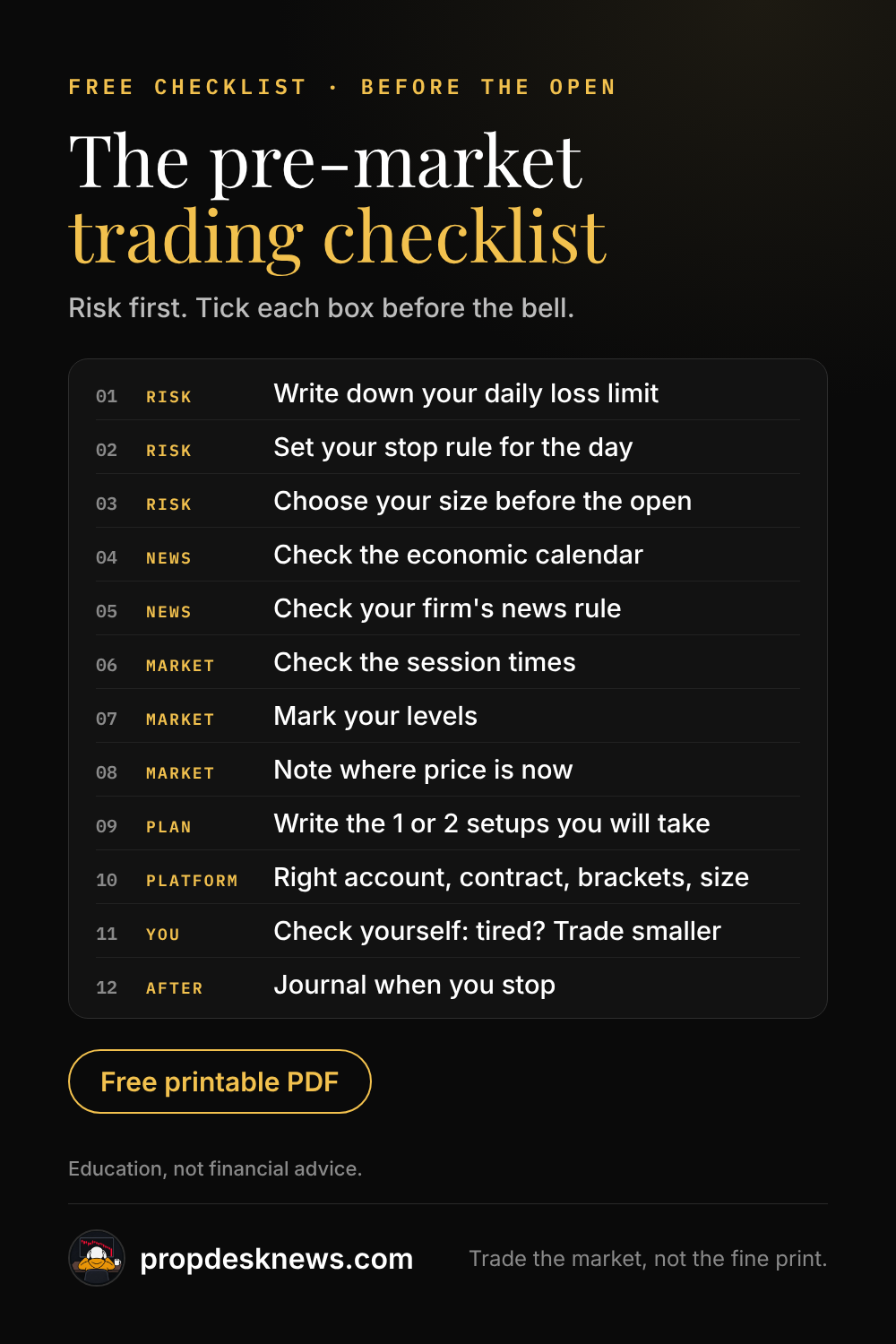
Work through it in order. The first three steps are about risk, because they're the ones you skip when you're in a hurry.
The step I never skip is the news check. A release I wasn't ready for has cost me before.
| Step | Area | What to do |
|---|---|---|
| 1. Write down your daily loss limit in dollars | Risk | If you trade a prop account, also write where the drawdown line sits today. These two numbers decide everything else. |
| 2. Set your stop rule for the day | Risk | For example: stop after two losing trades, or once you hit the daily loss limit, whichever comes first. |
| 3. Choose your size before the open | Risk | Contracts = risk per trade divided by (stop in points x point value). One MNQ point is $2, one MES point is $5. |
| 4. Check the economic calendar | News | Note the time of every big release today, such as CPI, the jobs report or a Fed decision. Decide now whether you sit out around them. |
| 5. Check your firm's news rule | News | Some prop firms limit trading around major releases. Read your firm's rule before the release, not after. |
| 6. Check the session times | Market | CME equity futures trade nearly 24 hours, with a daily break. Holidays can mean an early close. |
| 7. Mark your levels | Market | Yesterday's high, low and close, and the overnight high and low. |
| 8. Note where price is now | Market | Above, below or inside yesterday's range? This tells you which setups make sense today. |
| 9. Write the one or two setups you will take | Plan | If a trade isn't one of them, you don't take it. |
| 10. Check the platform | Platform | Right account, right contract month, bracket orders on, default size set to today's size. |
| 11. Check yourself | You | Slept badly, upset or rushed? Trade smaller, trade sim, or skip the day. |
| 12. Journal when you stop | After | Log every trade and one thing to fix tomorrow. The free journal template does the math. |
Free printable checklist (PDF)
One page, with a tick box for each step and space to write your loss limit, levels and setups. Free, no email.
Why risk comes before levels
Levels and setups feel like the real work, so they're what most traders check first. But a good setup doesn't help if one bad trade can take out your day.
Write the loss limit and the stop rule first, while you're calm. To turn a stop into a size, use the position size calculator. On a prop account, the drawdown runway calculator shows how many losing days you have left.
Checking the news calendar
Scheduled US releases come out at set times. The Bureau of Labor Statistics publishes its release schedule (CPI, the jobs report), and the Federal Reserve publishes its meeting calendar.
Prop firms differ on news. Some let you trade through releases, others restrict it. Topstep, for example, has a help-center page on economic releases.
Read your own firm's rule; our firm pages link each firm's rules.
After the session
The checklist ends when you stop trading. Log every trade the same day, while you still remember why you took it.
The free trading journal template works out planned risk, result and R for you, and has a daily review tab that shows how close you came to your loss limit.
Save this checklist
Questions
What should be on a pre-market trading checklist?
Your daily loss limit, a stop rule for the day, your size, today's news releases and your firm's news rule, your levels, the setups you will take, and a platform check.
Is the pre-market checklist PDF free?
Yes. It downloads straight from this page with no email and no sign-up.
Why put risk first on a trading checklist?
Because the risk steps are the ones traders skip when they're rushed, and they decide how much one bad trade can cost.
Sources
Read on Nov 12, 2026:
- U.S. Bureau of Labor Statistics: Release calendar ↗
- Federal Reserve: FOMC meeting calendars ↗
- CME Group: Trading hours ↗
- Topstep Help Center: Economic releases ↗
Spot something out of date? Email hello@propdesknews.com and we'll fix it.
Related guides
Free trading journal template for futures traders
Free Google Sheets, Excel and PDF journal: 18 columns, risk and R filled in for you. No email.
Updated Nov 12, 2026
How much money do you need to start trading futures?
$0 sim, a $49-$675 prop evaluation, or your own account: real numbers, and what a bad week costs.
Updated Nov 12, 2026

The 1% rule in trading, with real futures numbers
1% of $50K is $500 a trade. On a 50K prop account, that is a quarter of the drawdown.
Updated Nov 12, 2026