
The short version
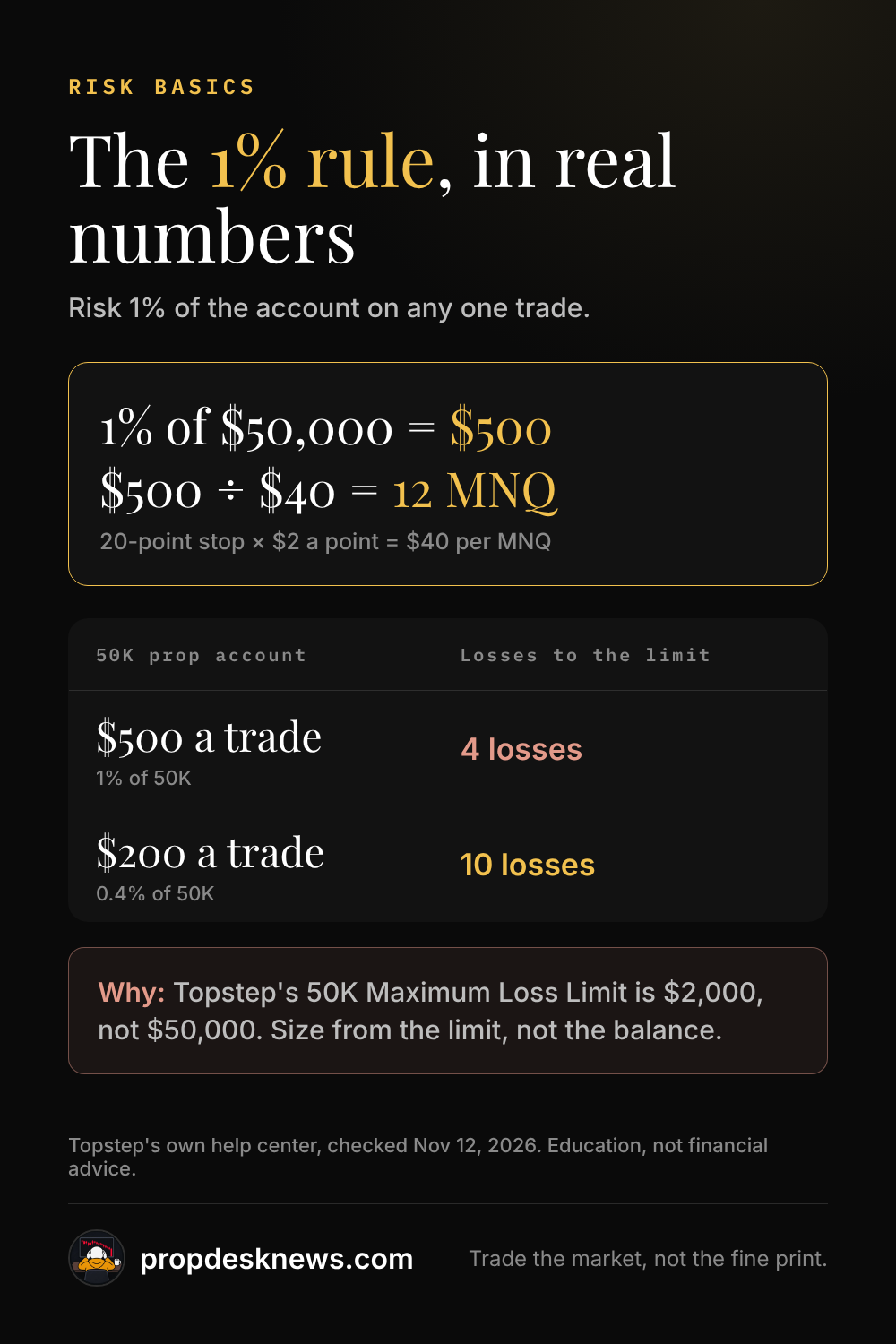
- The 1% rule: risk at most 1% of your account per trade. On $50,000 that is $500.
- Size from the stop: one MNQ point is $2, so a 20-point stop risks $40 per contract. $500 allows 12 MNQ.
- A $50K prop account isn't $50,000 you can lose. Topstep's 50K Maximum Loss Limit is $2,000 (checked Nov 12, 2026).
- Risking $500 a trade there means 4 straight losses end the account. Sizing from the drawdown, such as 10% of it ($200), gives you 10.
- Use the position size calculator to turn any risk number into contracts.
Education, not financial advice. The examples are arithmetic, not recommendations; slippage and fees can make a loss bigger than the stop.
What the 1% rule says
Pick the most you'll lose on any one trade before you take it, and keep it at 1% of your account or less. On a $50,000 account that's $500; on $10,000 it's $100.
On a 50K prop account I size from the drawdown, not the balance. 1% of $50,000 is $500, a quarter of a $2,000 max loss, and that is too much for one trade.
The point isn't the exact number. It's that a losing streak, which every trader has, costs you a slice of the account instead of the account.
Worked example: a $50,000 account
1% of $50,000 is $500. Turn that into contracts with your stop: risk per trade divided by (stop in points x point value).
| Trade | Risk per contract | Contracts for $500 | Total risk |
|---|---|---|---|
| MNQ, 20-point stop | $40 | 12 | $480 |
| MES, 8-point stop | $40 | 12 | $480 |
| MES, 20-point stop | $100 | 5 | $500 |
MNQ point $2, MES point $5 (CME Group, checked Nov 12, 2026). Round down, never up. Before fees.
Why a $50K prop account is different
A $50K evaluation lets you trade a $50,000 balance, but you can only lose the drawdown. At Topstep, the 50K Maximum Loss Limit is $2,000, trailing your end-of-day balance; Topstep also caps the 50K at 5 contracts or 50 micros.
So the 1% rule, applied to the balance, risks a quarter of everything you can lose on each trade. Size from the drawdown instead.
| Risk per trade | Share of balance | Share of the $2,000 limit | Straight losses to the limit | MNQ size |
|---|---|---|---|---|
| $500 | 1% of $50,000 | 25% of $2,000 | 4 | 12 MNQ ($480) |
| $200 | 0.4% of $50,000 | 10% of $2,000 | 10 | 5 MNQ ($200) |
| $100 | 0.2% of $50,000 | 5% of $2,000 | 20 | 2 MNQ ($80) |
Straight losses counted from the start, before the trailing line moves up. Topstep figures from its help center, checked Nov 12, 2026; other firms' limits differ.
See your own firm's numbers with the drawdown runway calculator.
When 1% is too much
1% is a ceiling, not a target. Go smaller while you're learning, after a losing streak, and on days with big scheduled news.
On very small accounts the rule can say you can't trade at all: 1% of $2,000 is $20, less than one MNQ contract with a 20-point stop. That's a sign to keep practicing on a simulator, not to break the rule.
Save this for later
Questions
What is the 1% rule in trading?
Risk no more than 1% of your account on one trade: $500 on a $50,000 account.
Does the 1% rule work on a prop firm account?
Not on the balance. On a 50K prop account you can only lose the drawdown, $2,000 at Topstep, so size from that number instead.
How many MNQ contracts is 1% of $50,000?
With a 20-point stop, 12. Each MNQ contract risks $40 on 20 points, and 12 contracts risk $480.
Sources
Read on Nov 12, 2026:
- CME Group: Micro E-mini Nasdaq-100 contract specs ↗
- CME Group: Micro E-mini S&P 500 contract specs ↗
- Topstep Help Center: What is the Maximum Loss Limit? ↗
- Topstep Help Center: Trading Combine parameters ↗
Spot something out of date? Email hello@propdesknews.com and we'll fix it.
Related guides

How much money do you need to start trading futures?
$0 sim, a $49-$675 prop evaluation, or your own account: real numbers, and what a bad week costs.
Updated Nov 12, 2026

Pre-market trading checklist for futures traders
12 steps before the open, risk first. Free printable PDF.
Updated Nov 12, 2026
Your first prop firm challenge: what to expect
Cost, 1 step vs 2 step, what happens when you pass or fail, and the age rule, from each firm's own pages.
Updated Nov 11, 2026