
The short version
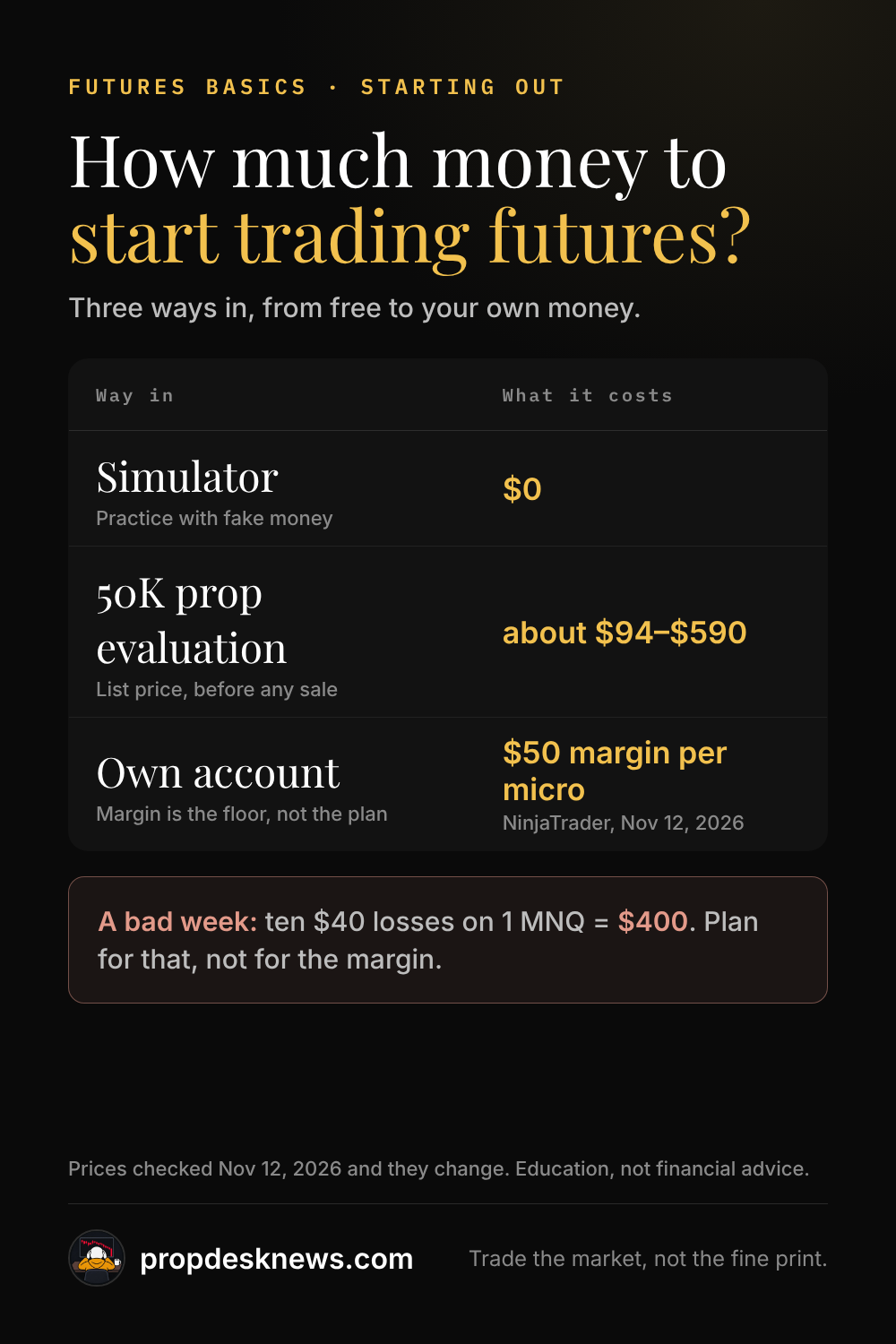
- A simulator costs $0: NinjaTrader's sim and TradingView's paper trading are both free.
- A 50K prop evaluation lists from $49 a month (Topstep's Standard path, plus $149 after you pass) to $675 one time (IQ Capital Core), counting the lowest-priced plan at each of 37 futures firms, checked Nov 14, 2026. Pay-after-pass plans start lower: For Traders asks $39 now, then $329 once you pass. The most you can lose is the fee and any resets.
- In your own account, NinjaTrader listed $50 intraday margin per micro (MES, MNQ) and $500 per E-mini S&P 500 (ES) on Nov 12, 2026. Margin is the minimum to open the trade, not what you need.
- Size the account from your worst week: ten $40 losses on one MNQ is $400; ten losses on one ES with an 8-point stop is $4,000.
- Most beginners should start on sim, move to one micro, and only then think about a full-size contract.
Education, not financial advice. Futures trading can lose money quickly, including more than you put in a broker account. Prices and margins change; check the date on each number.
Micro futures
Micro futures are one tenth the size of the classic E-mini contracts, which is why they're where most beginners start. One MES point is $5 against $50 on ES; one MNQ point is $2 against $20 on NQ (CME Group specs, read Nov 10, 2026).
If I were starting over, I'd spend a month on a simulator, backtesting, or paper trading on TradingView before paying for any evaluation.
Smaller size means smaller losses while you learn. A 20-point stop on one MNQ risks $40; the same stop on one NQ risks $400.
| Contract | Per tick | Per point | Full-size pair |
|---|---|---|---|
| MNQ | $0.50 | $2 | NQ: $5 per tick, $20 per point |
| MES | $1.25 | $5 | ES: $12.50 per tick, $50 per point |
All 12 contracts are on the futures tick value cheat sheet.
Your own account vs a prop evaluation vs sim
There are three ways to start, and each puts a different amount of money at risk.
| Path | What you pay up front | The most you can lose | Good to know |
|---|---|---|---|
| Simulator | $0 (NinjaTrader sim, TradingView paper trading) | Nothing | Fills are simulated, so results look better than live. Build the habit here first. |
| 50K prop evaluation | About $49 to $675 upfront at list price; some firms add an activation fee (Topstep $149, Apex Intraday Trail $99). Pay-after-pass plans start at $39 now plus $329 once you pass (For Traders) | The fee, plus any resets | You trade the firm's simulated account under its loss limits. Most traders don't pass; see our pass rates guide. |
| Your own account, micros | Broker day-trade margin, e.g. $50 per micro at NinjaTrader (Nov 12, 2026), plus commissions and data fees | Your whole balance, and in a fast market more than that | Margin is a floor, not a plan. The broker can raise it without notice, and NinjaTrader's intraday margin ends at 3:45 p.m. CT. |
Evaluation prices above are list prices for 50K accounts from our True Cost Index. To add up the full cost of an evaluation, with resets and activation fees, use the true cost calculator.
New to evaluations? How prop firms work explains what you're buying.
What a bad week costs
The real answer to "how much do I need" is: enough to take a bad week without changing how you trade. Work it out from your stop, not from the margin.
Say you take two trades a day and lose every one of them for a week. That's ten losses.
| Trade | One loss | Ten losses |
|---|---|---|
| 1 MNQ, 20-point stop | $40 | $400 |
| 1 MES, 8-point stop | $40 | $400 |
| 1 ES, 8-point stop | $400 | $4,000 |
| 1 NQ, 20-point stop | $400 | $4,000 |
Before commissions. Ten straight losses is rare but it happens, and slippage on a fast day can make a loss bigger than the stop.
On a prop evaluation the same week hits the firm's loss limit instead of your bank account: $400 fits inside a typical 50K drawdown, $4,000 doesn't. Check yours with the drawdown runway calculator, and size each trade with the position size calculator.
Comparing evaluations? Our side-by-side comparison lists rules and prices.
Save this for later
Questions
How much money do you need to start trading futures?
$0 to practice on a simulator. A 50K prop evaluation lists from about $49 to $675 upfront (pay-after-pass plans start at $39 now plus $329 once you pass).
In your own account, NinjaTrader asked $50 day-trade margin per micro on Nov 12, 2026, but you need enough to cover a bad week, not just the margin.
Can you trade futures with $100?
You can open one micro contract at a broker with $50 day-trade margin, but one bad trade could wipe out the account. A free simulator, or a prop evaluation where the fee is the most you can lose, is a safer way to learn.
What is the cheapest way to start trading futures?
A simulator, which is free at NinjaTrader and on TradingView. After that, one micro contract (MES or MNQ) keeps each loss small.
Is margin the same as the money you need?
No. Margin is the minimum the broker holds to let you open a trade. Your losses come out of your whole balance, and the broker can raise margin without notice.
Sources
Read on Nov 12, 2026:
Show all 6 sources
- NinjaTrader: Futures margins and position management ↗
- NinjaTrader: Free trading simulator ↗
- TradingView: Paper trading main functionality ↗
- CME Group: Micro E-mini Nasdaq-100 contract specs ↗
- CME Group: Micro E-mini S&P 500 contract specs ↗
- Prop Desk True Cost Index (firms' list prices, checked Nov 4, 2026) ↗
Spot something out of date? Email hello@propdesknews.com and we'll fix it.
Related guides
How prop firms really work: straight answers
Demo or live, who pays you, brokers, commissions, slippage and call-ups to live, answered from each firm's own rules.
Updated Nov 11, 2026

Your first prop firm challenge: what to expect
Cost, 1 step vs 2 step, what happens when you pass or fail, and the age rule, from each firm's own pages.
Updated Nov 11, 2026

How to open a Topstep Practice Account
The four clicks to add Topstep's free 150K Practice Account, who qualifies, the 15-lot limit, and how resets and closing work.
Updated Nov 7, 2026