The short version
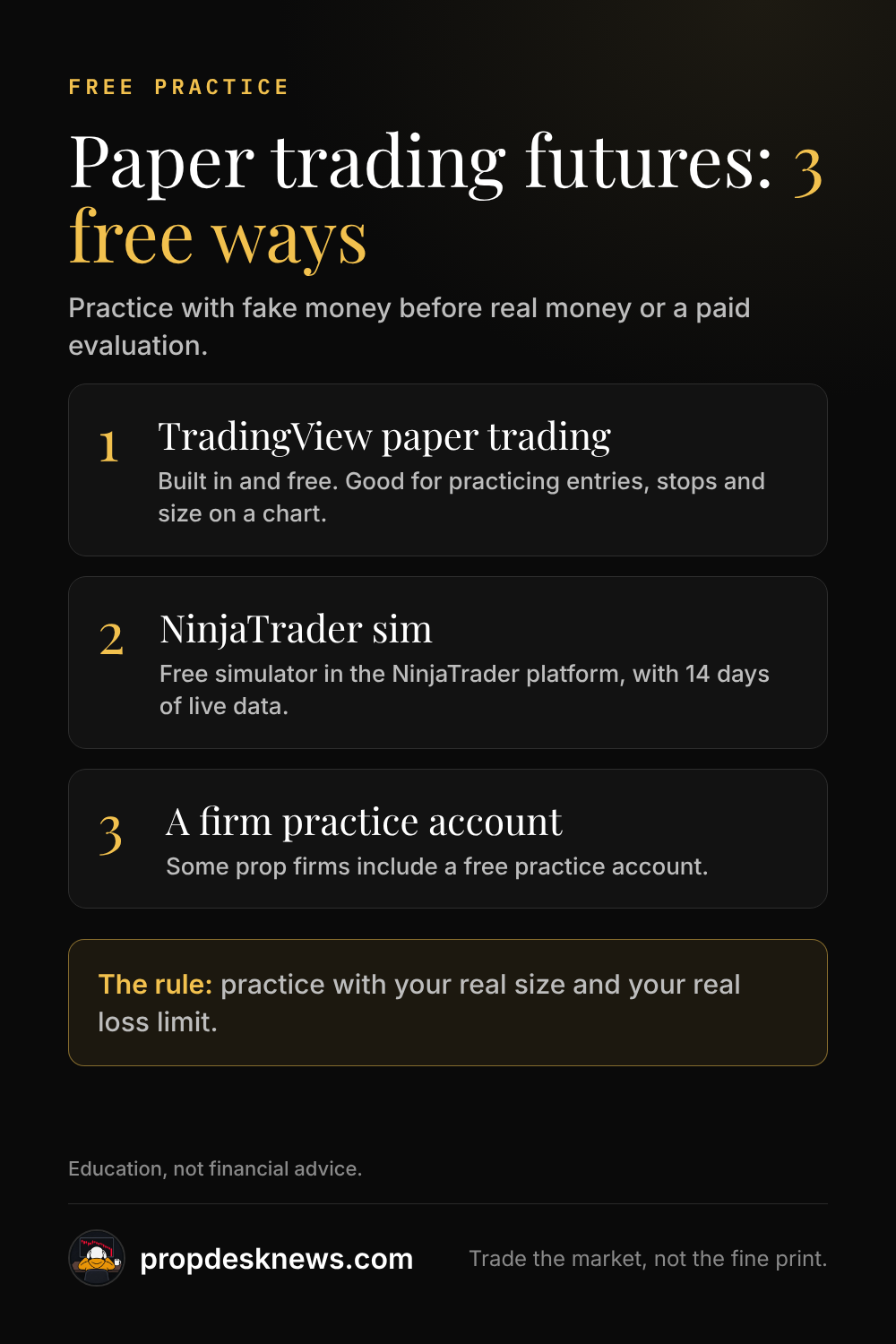
- TradingView paper trading is free, needs no deposit, and covers index and commodity futures, per TradingView.
- NinjaTrader's simulator is free, with 14 days of live data, per NinjaTrader.
- Some prop firms give a practice account; see our Topstep practice account guide.
- A prop evaluation is also simulated, but you pay a fee and the loss limits are real rules.
- Practice counts only if you trade your real size, your real loss limit and your real plan.
Education, not financial advice. Simulated results can look better than live trading because fills are easier in a simulator.
Free ways to paper trade futures
All three cost nothing and use fake money.
| Option | Cost | What you get | Watch out for |
|---|---|---|---|
| TradingView paper trading | Free, no deposit | Practice on TradingView charts; index and commodity futures supported | Check whether your futures data is real-time or delayed on your plan |
| NinjaTrader simulator | Free | Simulated trading in the NinjaTrader platform, with 14 days of live data | After the live-data period, check what data you have |
| A prop firm practice account | Free with some firm accounts | The same platform and rules screen you'll use in an evaluation | Not every firm offers one; see the Topstep practice account |
Sim vs paper vs prop evaluation
"Sim" and "paper" mean the same thing in practice: trading with fake money. The difference that matters is between free practice and a paid evaluation.
Sim trading never felt the same to me as an evaluation I had paid for. The fee is small, but it changes how you click.
| Question | Paper or sim | Prop evaluation |
|---|---|---|
| Cost | $0 | A fee, about $49 to $675 upfront for a 50K at list price |
| Loss limit | Only if you set one | The firm's drawdown and daily rules, enforced |
| Money at risk | None | The fee, plus any resets |
| What it proves | Your process | That you can follow the firm's rules under pressure |
Evaluation prices are from our True Cost Index (list prices, checked Nov 4, 2026). How prop firms work explains what you're paying for.
How to make paper trading count
- Trade the size you'd trade live, usually one micro. Ten contracts on a sim teaches you nothing about one.
- Set a daily loss limit and stop when you hit it, as a firm would make you.
- Use the pre-market checklist every day.
- Journal every trade in the free journal template.
- Expect live fills to be a little worse than sim fills.
When to move on from paper trading
There's no magic number of days. A fair test: a month or more of following your plan on almost every trade, with losing days that stay inside your loss limit.
Then decide between one micro in your own account and a prop evaluation. How much money you need to start compares the two.
Save this for later
Questions
Can you paper trade futures for free?
Yes. TradingView paper trading and NinjaTrader's simulator are both free, and some prop firms include a practice account.
Is sim trading the same as paper trading?
In practice, yes. Both mean trading with fake money. A prop evaluation is different: you pay a fee and trade under the firm's loss limits.
Is a prop evaluation real money?
At most futures firms the evaluation is a simulated account. The money at risk is the fee you pay, plus any resets.
Sources
Read on Nov 12, 2026:
- TradingView: Paper trading main functionality ↗
- NinjaTrader: Free trading simulator ↗
- Prop Desk True Cost Index (firms' list prices, checked Nov 4, 2026) ↗
Spot something out of date? Email hello@propdesknews.com and we'll fix it.
Related guides
How to open a Topstep Practice Account
The four clicks to add Topstep's free 150K Practice Account, who qualifies, the 15-lot limit, and how resets and closing work.
Updated Nov 7, 2026
How much money do you need to start trading futures?
$0 sim, a $49-$675 prop evaluation, or your own account: real numbers, and what a bad week costs.
Updated Nov 12, 2026
How prop firms really work: straight answers
Demo or live, who pays you, brokers, commissions, slippage and call-ups to live, answered from each firm's own rules.
Updated Nov 11, 2026